


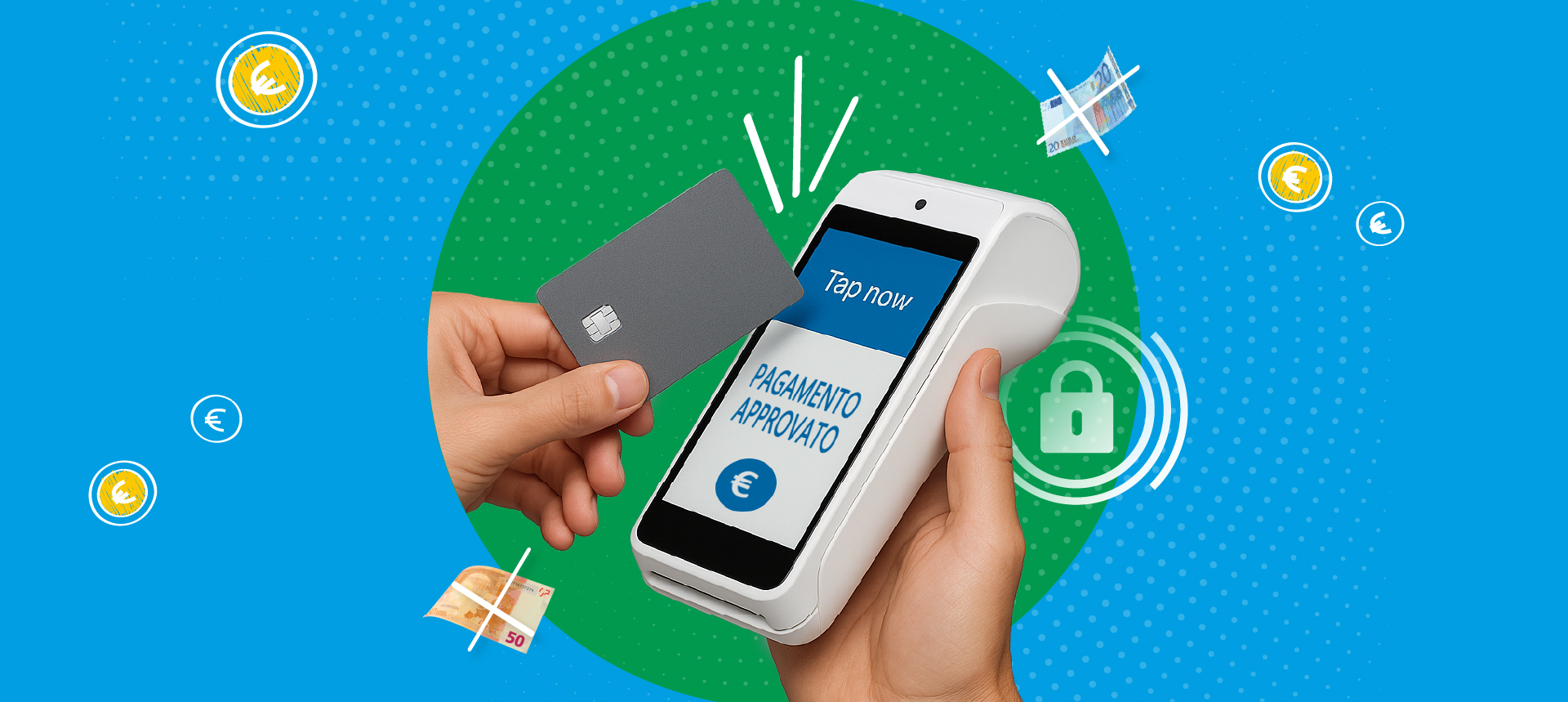
The idea of a cashless society — a world where physical money disappears — is becoming increasingly relevant. The growth of digital payments through cards, apps, and electronic wallets is profoundly transforming how consumers and businesses manage money. But is a world without banknotes truly more efficient and secure? In this article, we explore the benefits, risks, and implications of a cashless society.
What is a cashless society
A cashless society is an economic system in which transactions and payments take place almost exclusively through digital means, reducing or even eliminating the use of cash. Concrete examples can already be seen in countries such as Iceland and, to some extent, Sweden and China, where smartphone payments have become the norm.
Which payment methods do Italians prefer?
In Italy, digital payments are growing rapidly. Despite the persistent preference for cash, by the end of 2023 around 40% of the total transaction value was made using payment cards and digital wallets. This represents an 18% increase in card payments, a growth rate far above the European average of around 11%.
Although Italy still ranks among the last countries in Europe for the number of digital payments per person (ahead only of Germany, Romania, and Bulgaria), habits are changing quickly.
We are approaching a turning point where digital payments (via cards, apps, and smartphones) will catch up with cash, which still accounts for 44% of transactions today.
Thanks to new technologies and increasingly fast and convenient payment methods, it is very likely that Italy will move up the European ranking in the coming years.
Advantages of a cashless society
According to Lucia Leonelli, Professor of Financial Intermediaries at the University of Rome Tor Vergata, the advantages of a cashless society include:
- Greater traceability and fight against tax evasion
Digital payments leave a record, making it harder to evade taxes or engage in illegal activities. The digitalization of payments also contributes to reducing the shadow economy. - Convenience and speed
Paying by smartphone or card is fast and practical, avoiding the need to withdraw cash or handle change. - Physical security
Less cash means lower risks of theft, robbery, or loss.
Risks and challenges of a cashless society
- Digital exclusion
Not everyone has access to digital tools or the skills to use them. Elderly people, those with lower incomes, or residents in rural areas could be left behind. - Dependence on infrastructure and Big Tech
A blackout, system failure, or cyberattack could completely block payments, with immediate effects on citizens and businesses. - Privacy and surveillance
Every digital transaction is traceable. In a cashless society, financial freedom could be compromised if governments or corporations can monitor purchases. - Reduced awareness of spending
Using cash makes it easier to visualize how much we spend, helping us keep track of our expenses.
Why we spend more (and remember less) when paying by card
Consumer psychology studies show that paying by credit card changes our relationship with money. Researcher Dilip Soman (insert source link) observed that many people struggle to recall how much they spent when using a card. In one of his experiments, Soman interviewed 41 students who had just made purchases at a campus bookstore. Among those who paid by credit card, only 35% could recall the exact amount, while most underestimated their spending or couldn’t remember at all.
This happens because using a credit card creates a mental distance from the moment of payment. When we pay in cash, we physically see money leaving our wallet and the cost feels real and immediate. With a card, the transaction is fast and almost invisible, so the brain perceives less “pain” in spending. Experts call this phenomenon “decoupling”, meaning the separation between the act of buying and the act of paying.
The future: the digital euro
Central Banks are developing official digital currencies such as the digital euro. It is important to note that this is not a cryptocurrency, but an electronic version of the euro, safe and controlled by the European Central Bank.
The digital euro would be a free and accessible means of electronic payment, as secure and universal as cash is today, usable across all eurozone countries. In an increasingly digital society, it represents the natural evolution of the single currency.
Conclusion
A cashless society offers significant opportunities in terms of efficiency, security, and transparency. However, to prevent it from becoming an exclusive or overly controlled system, it is crucial to ensure digital inclusion, privacy protection, and reliable infrastructure. The future of payments will almost certainly be digital, but the path toward it must be built with balance and responsibility.
To deepen your financial literacy and improve your money management skills, follow our blog, visit www.museodelrisparmio.it, and stay up to date on the many activities and events you can also join online.
15 October 2025