

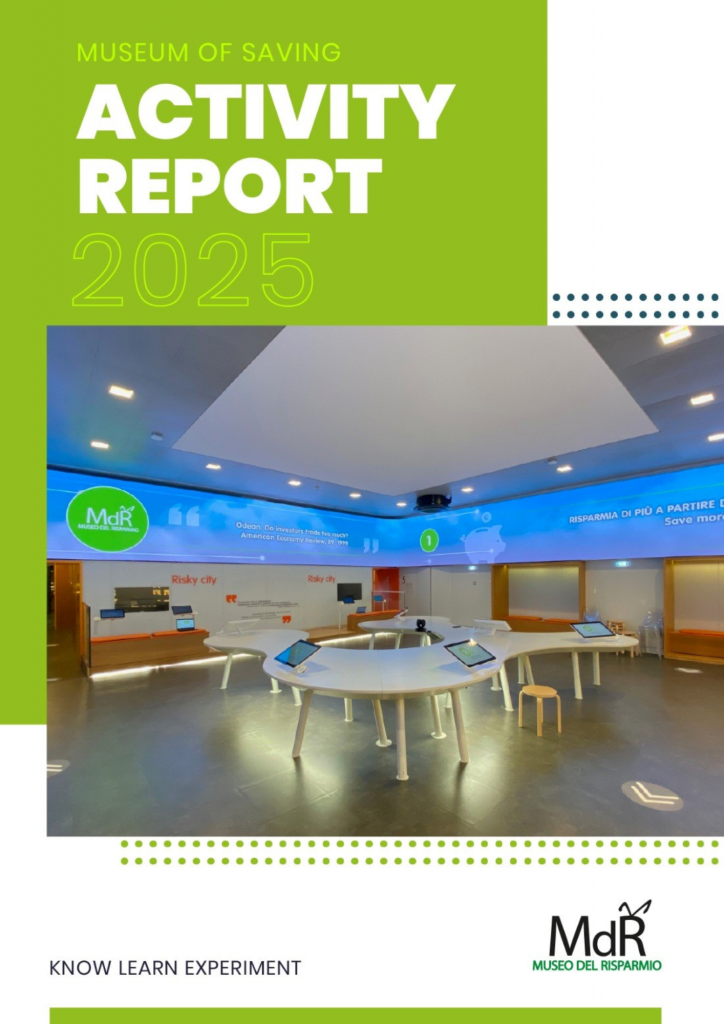
In 2025, the Museum of Saving consolidated and expanded its role in promoting financial education, confirming its strategic value for the well-being of individuals and the community in a context still characterized by wide gaps in financial literacy. The Museum’s action focused on the dissemination of accessible, useful, and understandable economic skills throughout the entire life cycle, through a model based on edutainment, research, and impact evaluation, capable of effectively integrating physical and digital dimensions.
Over the course of the year, outreach and educational activities involved a total of 154,037 users, including 132,504 students from primary and secondary schools and 21,533 adults, reached through events, dedicated initiatives, and educational visits. By combining physical and digital channels, the Museum extended its activities across the entire national territory, with 18,970 participants in in-person activities and 135,067 users involved in distance learning programs.
More than 2,500 hours of training and the high number of initiatives testify to a growing and increasingly informed demand for high-quality financial education.
The work carried out with the school system was particularly significant, also considering the inclusion of financial education in the mandatory Civic Education curriculum. The awarding of the “Quality Labels” by the National Committee for Financial Education and the wide participation in our programs confirm the reliability and effectiveness of the Museum’s offerings in supporting teachers and students.
At the same time, the Museum intensified institutional collaborations and promoted inclusive projects aimed at youngsters, women, families, seniors, and people in vulnerable conditions, in the belief that financial knowledge represents a fundamental tool for autonomy, protection, and dignity.
The Report thus presents the picture of a particularly intense year and of a mission oriented toward the future, with a constant commitment to innovating language, formats, and content, while maintaining scientific rigor, independence, and attention to the real needs of citizens, in order to contribute concretely to a more informed, inclusive, and aware society.
Read the 2025 Activity Report to discover all the initiatives in detail.