

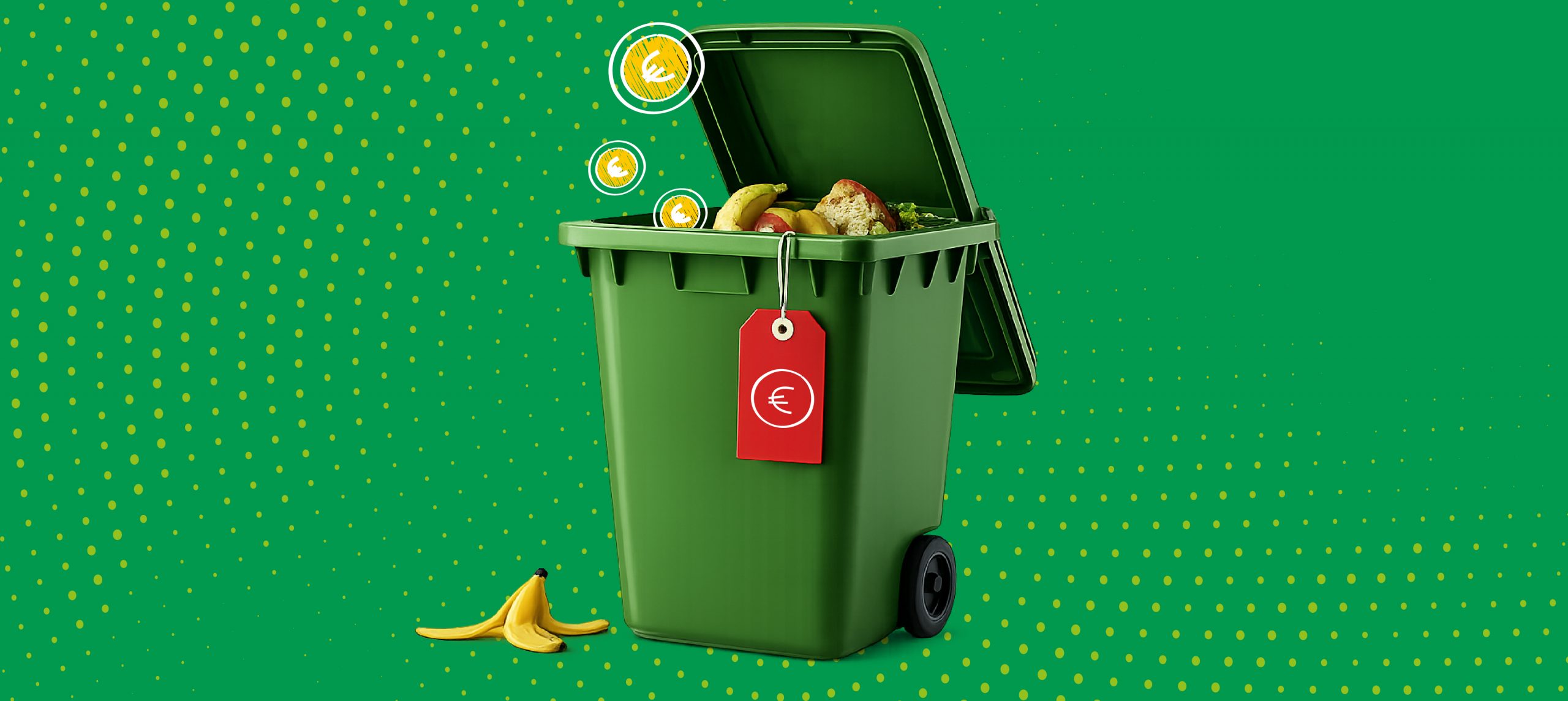
Every day we perform automatic actions: we shop for groceries, cook, and store food. And often, carelessly, we throw food away.
What we see is an expired or leftover product. What we do not see is the money we are losing.
Food waste, besides being an environmental and ethical issue, also represents a concrete economic problem that affects personal finances.
How much does food waste really cost us?
The numbers help us understand the scale of the phenomenon.
According to data from the Waste Watcher International Observatory reported by WWF Italy, more than 5 million tons of food are wasted every year in our country, worth around €7.3 billion at household level alone.
If we consider the entire supply chain, the cost becomes even higher: food waste in our country can reach up to €13.5 billion overall, including production, distribution, and consumption.
An even more significant figure emerged from an article published in September 2025 by Repubblica in its supplement Il Gusto: food waste in Italy can reach a value of €22 billion, an amount comparable to a national budget measure. The figure was highlighted by an awareness campaign launched by a sustainable delivery app which, on the occasion of the International Day of Awareness of Food Loss and Waste (29 September), “sent” Italians a letter resembling a payment notice from the Revenue Agency informing citizens about the introduction of a new tax, the so-called F.W.T. (Food Waste Tax), requiring an annual contribution of €378 per person, equal to 58 days of wasted grocery spending. A sum which, as specified to the recipient, “you are actually already paying.”
This campaign clearly highlighted the individual and visible impact of this systemic phenomenon. The food that ends up in the trash is not an exception but a collective behavior with enormous economic and environmental consequences.
It is not just an italian problem
The phenomenon is global and also affects the rest of Europe.
According to data provided by the European Parliament, more than 59 million tons of food are wasted every year in the European Union, equal to about 131 kg per person, for an economic value of €132 billion.
More than half (around 53%) of this waste comes from households, 7% from wholesale and retail trade, and 9% from restaurants and food services. The remaining waste in the EU is divided between primary production (11%) and food processing and manufacturing (20%).
This breakdown shows that waste is not only or mainly a “system” problem, but rather a matter of daily habits that can be changed and improved, even through small actions.
Just think that the food sitting in household refrigerators alone would be enough to provide 1.3 meals a day to every person affected by hunger worldwide.
Where everyday waste comes from
Household waste does not stem from a single cause, but from a series of common incorrect behaviors:
- buying more than necessary
- not planning meals
- storing food improperly
- confusing the expiration date with the best-before date
- forgetting food in the refrigerator
The invisible cost: not just what you pay at checkout
When we throw food away, we do not only lose the price of the product itself; we must also consider a series of invisible costs. Examples include the energy used to produce it, the water consumed during cultivation, transportation and distribution, and the time spent purchasing and preparing it.
This enormous waste represents both an economic and environmental loss.
Why it is important for young people to learn how to use food resources properly
For those living on a limited budget, food waste can have a greater impact than people realize.
Reducing waste without making sacrifices means optimizing weekly grocery shopping, avoiding unnecessary purchases, and above all developing greater financial awareness.
Providing food for oneself and one’s family correctly and responsibly is also part of the skills needed to build stronger long-term money management.
Some simple money-saving strategies can make a difference:
- planning meals before grocery shopping
- checking what is already available at home
- making a shopping list and sticking to it
- distinguishing between “use by” and “best before” dates
- reusing leftovers
It is not about giving things up, but about making better use of what we already have.
At a time when the cost of living is rising and around 32.6 million people in the EU cannot afford a quality meal (based on meat, chicken, fish, or a vegetarian equivalent) every two days, reducing food waste is one of the most immediate actions we can take both to improve our financial balance and to build a more ethical relationship with the rest of the world.
Avoiding the waste of food or financial resources means increasing our savings and improving our economic and moral daily life.
To avoid falling behind, invest in building financial education skills that will help you manage your money consciously: take part in the in-person and online activities of the Museum of Saving, follow our blog, and browse the many publications available on the website www.museodelrisparmio.it
And do not miss our sitcom dedicated to food waste: LISTEN UP
6 May 2026